
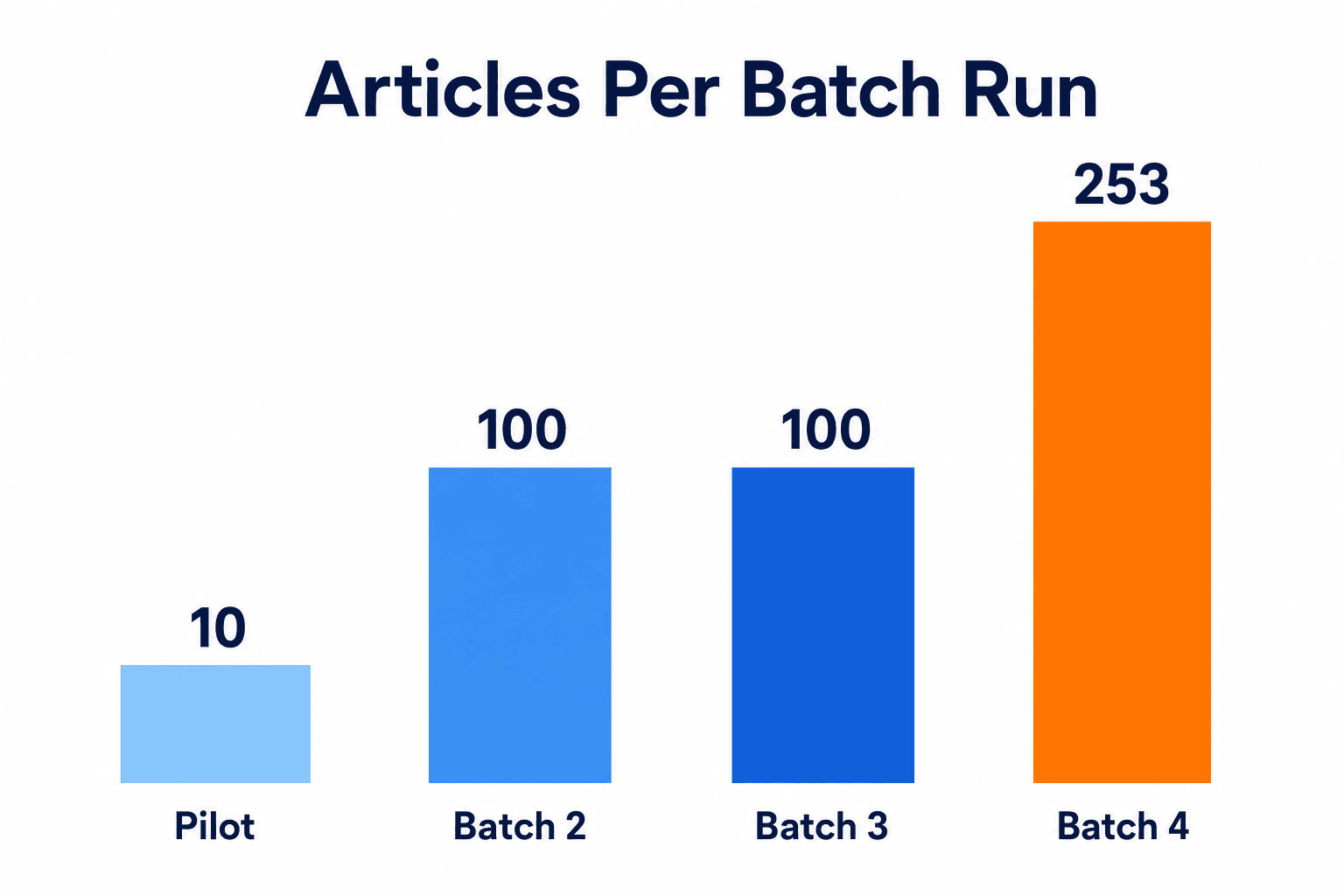
Bulk link building automation: 468 unique articles. 90 clients. 3 days.
Bulk AI content usually means the same detectable article 468 times. This pipeline was engineered to beat that, with machine enforced uniqueness, source verified facts, and zero manual send steps. Here is the full teardown, with the data and the profit.
Bulk Link Building Automation Case Study Results
- ~380,000 words of original, fact checked content across 468 articles with zero facts reused between any two articles
- 100% of orders sent automatically. No human touched a single email, document, or send step
- 120 live backlinks published within 24 hours of send (25.6% of the batch), average publisher rating of DR 57
- $36,170 profit on the batch after publisher fees, automation costs, and the one time build, a 65% margin
- The entire system was built and shipped in 3 days (~4,100 lines of code, 46 commits)
The whole case study in 32 seconds
One order in, 468 tracked articles out. Press play.
Bulk link building breaks teams. The AI shortcut gets you rejected.
A bulk link building order looks simple on a spreadsheet: 90 clients, 468 placements. In practice, every single placement needs a publisher vetted, a niche researched, a genuinely unique article written, an email sent, a reply chased, and a live link captured.
Do the math on doing that by hand and the batch stops being a project. It becomes a hiring plan.
The obvious shortcut, one AI prompt run 468 times, fails for a different reason. Single prompt bulk content converges on the same structure, the same phrasing, the same recycled claims. Publishers detect it, flag it, and reject it. The interesting engineering problem is not writing 468 articles. It is making sure no two of them feel like siblings.
Order sheet in. Live links out.
An end to end pipeline with no human in the writing loop, but hard quality gates at every stage. One dedicated AI agent per role, fanned out in parallel across all 90 clients.
3,417 publishers went in. 468 made the cut.
Before a single word was written, every candidate publisher passed through three hard gates: domain rating, cost ceiling, and turnaround speed. No exceptions, no manual overrides, and never the same publisher twice for one client.
The anti sameness machinery
This is what separates the pipeline from running one prompt 468 times. Uniqueness is not a style suggestion. It is mechanically enforced by a validator and a cross batch ledger that every article must clear before it is allowed to send.
120 live links within a day of send
Every one of the 468 articles was sent automatically, with zero manual send steps. The reply tracking loop then stamped live links as publishers responded. Here is how the batch converted:
Reply and live link counts were still climbing as publishers worked through the batch.
The automation cut placement costs by 51%
The pipeline auto negotiates each rate down to the lower of the marketplace cost or the publisher's own quoted price. Against the batch's $50 hard cap, placements cleared at an average of $24.69, a 51% cut. Against what the industry pays for a quality backlink, it is roughly 95% less: Editorial.Link's 2026 pricing study puts the average acceptable price for one quality backlink at $509, and around $600 for DR 50+ sites, the tier this batch averaged.
The full profit picture, nothing hidden
Most case studies stop at the cost savings. Here is the entire batch economics, including what the automation itself cost to build and run.
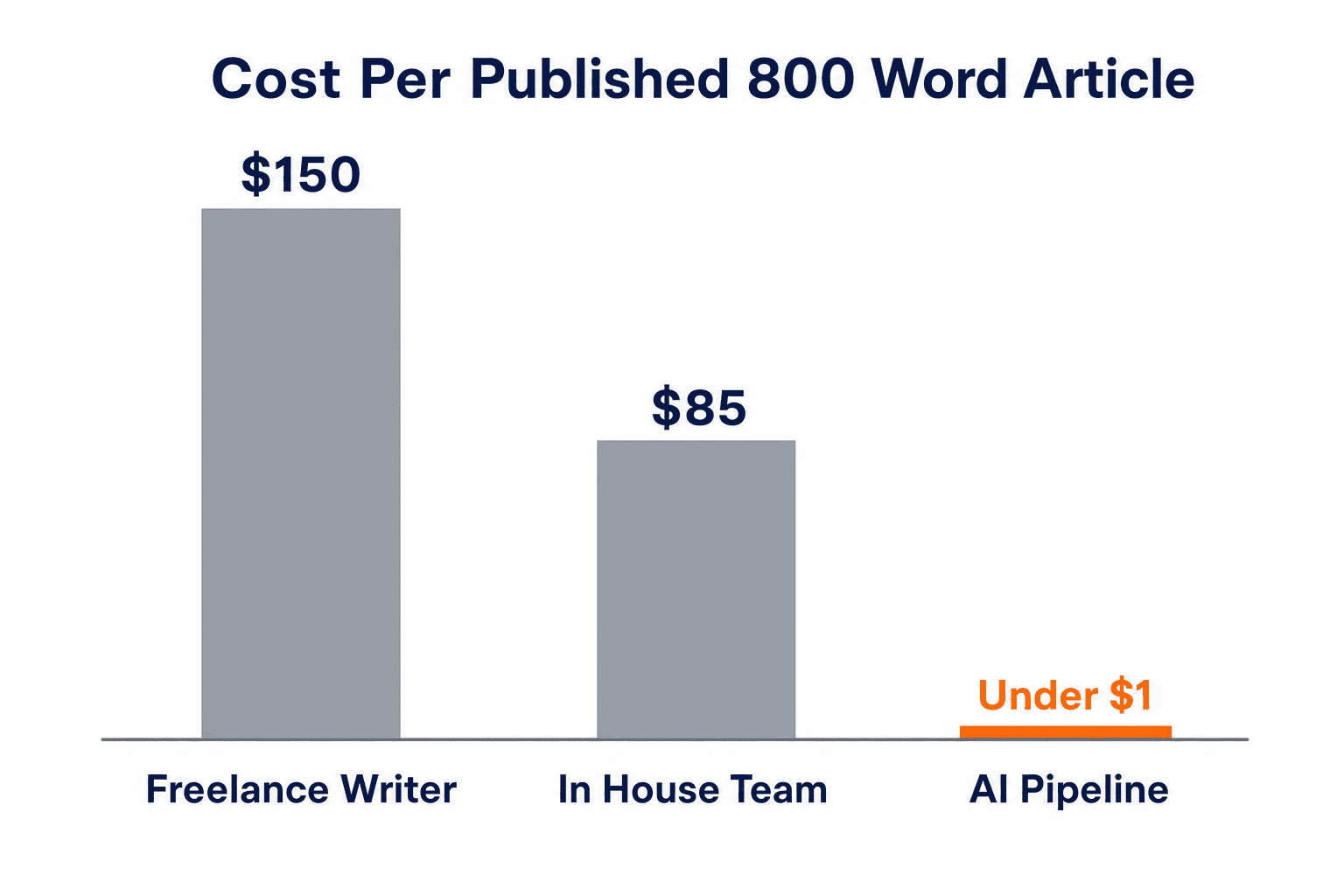
And the writing itself? About $1 per article.
The $24.69 goes to publishers. Producing each article, the research, the parallel writing agents, the 84 check validation loop, the document creation, the email delivery, and the reply tracking, costs about $1 per published article all in. Compare that to what the same 800 word article costs anywhere else:
Built and shipped in 3 days
First commit July 9. Batch complete July 11. Live links stamping themselves by July 12. The whole system is about 4,100 lines of code: a fully parallel agent pipeline (planner, research, and writer agents fanned out per client) feeding a single serialized document and send stage.
A note on timelines: this pipeline shipped fast because it lives on top of tools the client already used. Builds that integrate with ERPs, CRMs, or custom review portals typically run 6 to 12 weeks.
“Just use ChatGPT” vs. this pipeline
Any AI tool can draft an article. At 468 articles, the failure modes are sameness, unverified claims, and coordination overhead.
Same prompt, same structure, same claims, same tells. Publishers spot batch content immediately.
An angle ledger forbids any angle or fact appearing twice. 21 formats across 60 personas, with deterministic style dials per article.
The model writes from memory. Hallucinated stats get articles rejected, or worse, published.
A shared research stage verifies every fact at its source. Writers do zero web lookups and can only use verified facts from their brief.
A human skims some of the output, or nobody checks at all.
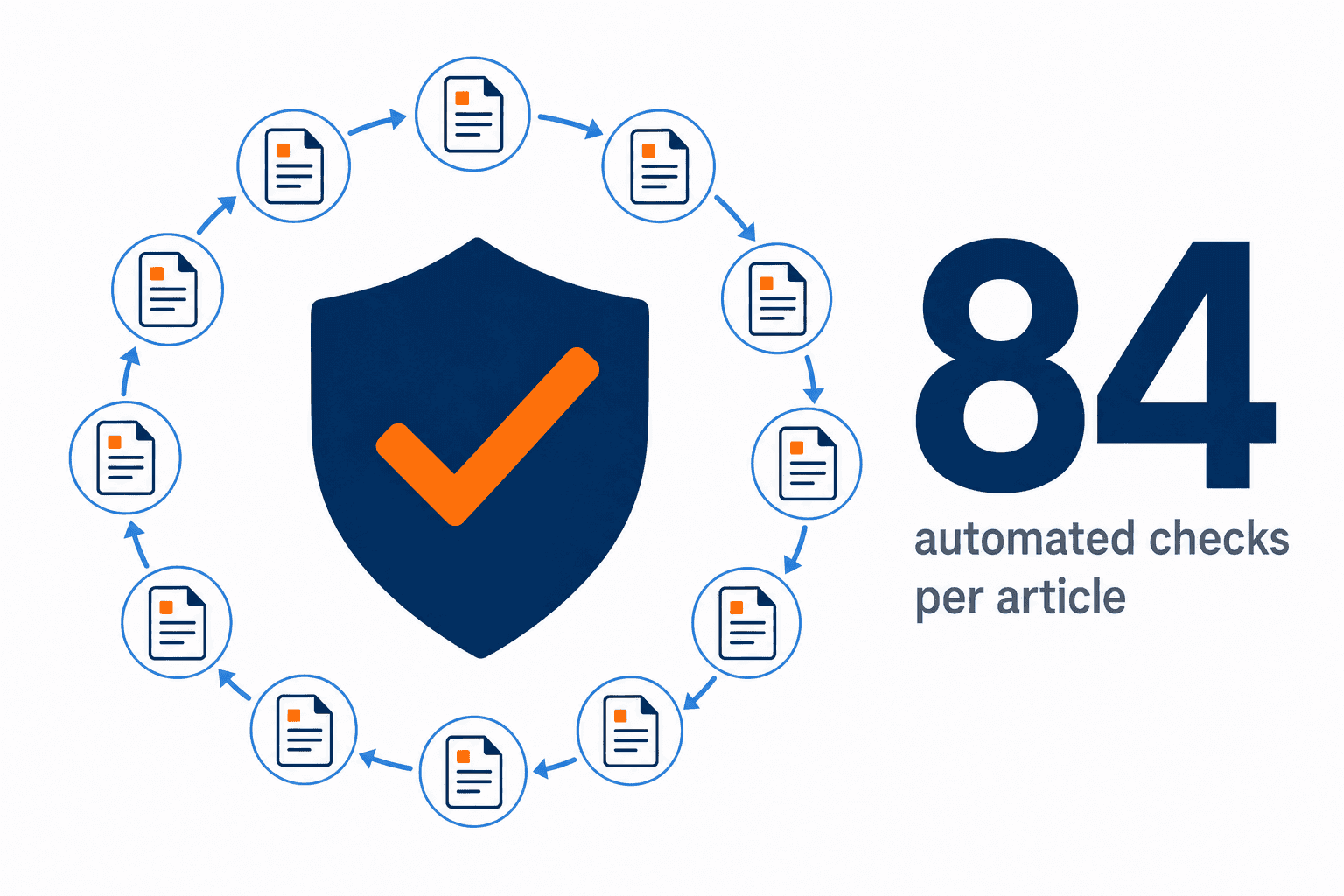
Every article must mechanically pass 84 checks covering keyword placement, link rules, banned phrases, and framing before it can send.
Someone copies each article into a doc, writes 468 emails, and tracks replies in their inbox.
Formatted Google Doc, auto emailed .docx, replies processed hourly, live link stamped, thread archived. Humans see pricing questions only.
“The goal was never cheap articles. It was making 468 articles that each feel like they came from a different human, with quality gates an editor could never apply 468 times without missing one, and a system that only interrupts a person for the decisions that deserve a person.”
Is link building automation a fit for your agency?
Not every operation should automate, and we will tell you when yours should not. But this case study's economics show up again and again when these boxes check:
- You place 50+ links per month across multiple clients
- Content uniqueness, not volume, is your rejection bottleneck
- Your team spends hours on publisher emails and reply chasing
- You buy placements from a marketplace and negotiate rates per order
- Your margins shrink every time volume grows
- A handful of placements per month
- Pure digital PR where every pitch is bespoke
- No defined publisher sourcing process yet
The fastest way to find out is a 30 minute conversation. Describe your volume, your marketplace, and your current process. You will get an honest yes or no and a ballpark scope on the call.
Start the ConversationLink building automation questions, answered
The questions agency owners ask after reading this case study.
What is bulk link building automation?
How much does link building automation cost to build?
Do publishers reject AI written articles in bulk?
How does $24.69 per placement compare to industry pricing?
Was the batch actually profitable?
Does a human review anything?
Who owns the system after it is built?
Your link building operation could run like this.
This agency turned a 468 placement order into a 65% margin batch that ran itself. Tell us about your volume and your process, and we will tell you honestly what is possible. Explore our AI Automation Builds and AI services to see what we can systematize for you.
30 minutes No commitment Honest ballpark scope